Why I built it
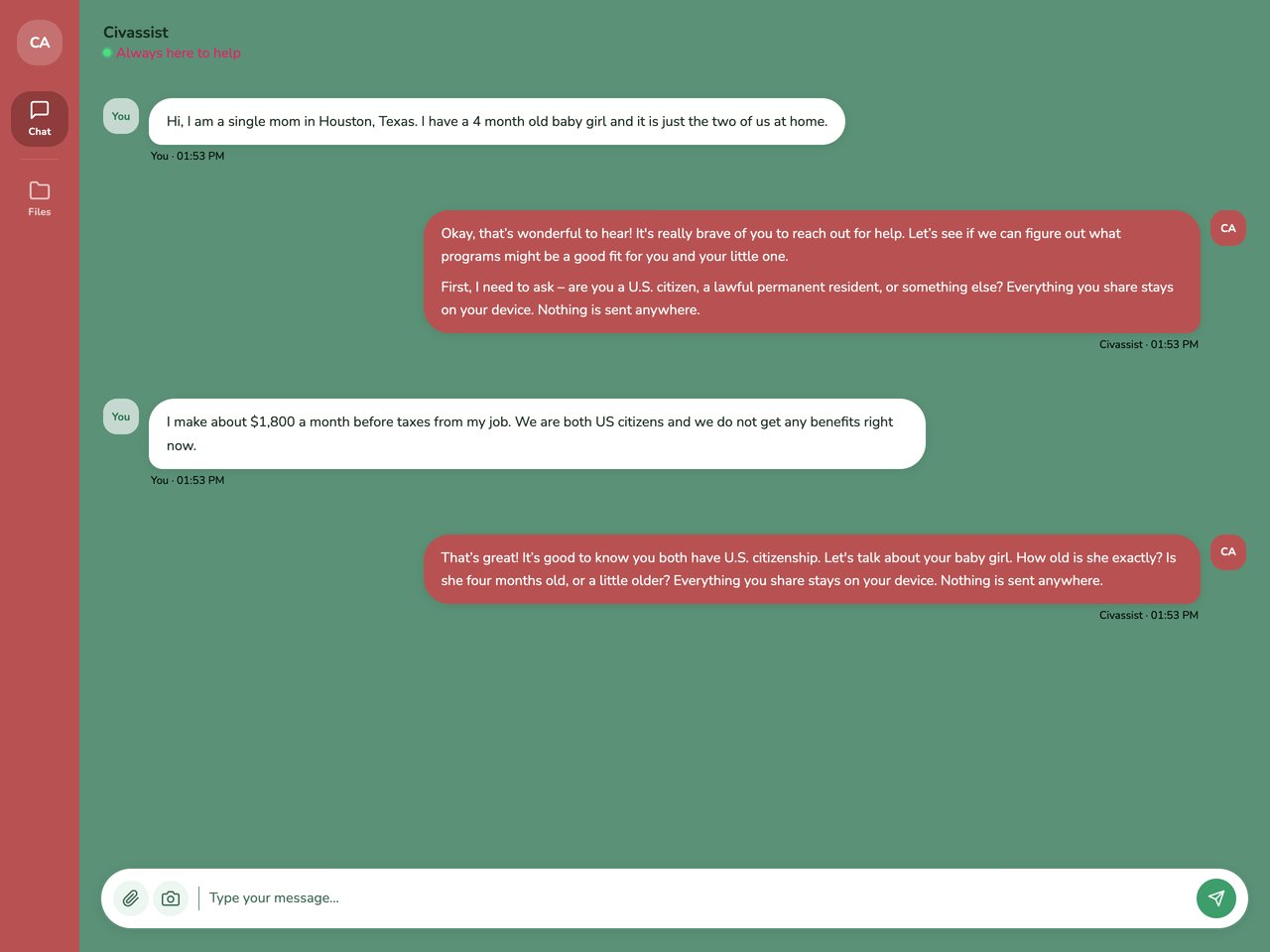
I wanted to work on something that helps people directly. To find out whether your family qualifies for Medicaid, CHIP, WIC or SNAP in Texas, you have to work through income charts and a state handbook that runs to hundreds of pages, and the answer depends on details like household size, age and pregnancy. Civassist asks those questions in a normal conversation and gives an answer. It runs entirely on the person's own computer, so their income, immigration status and family details never leave it.
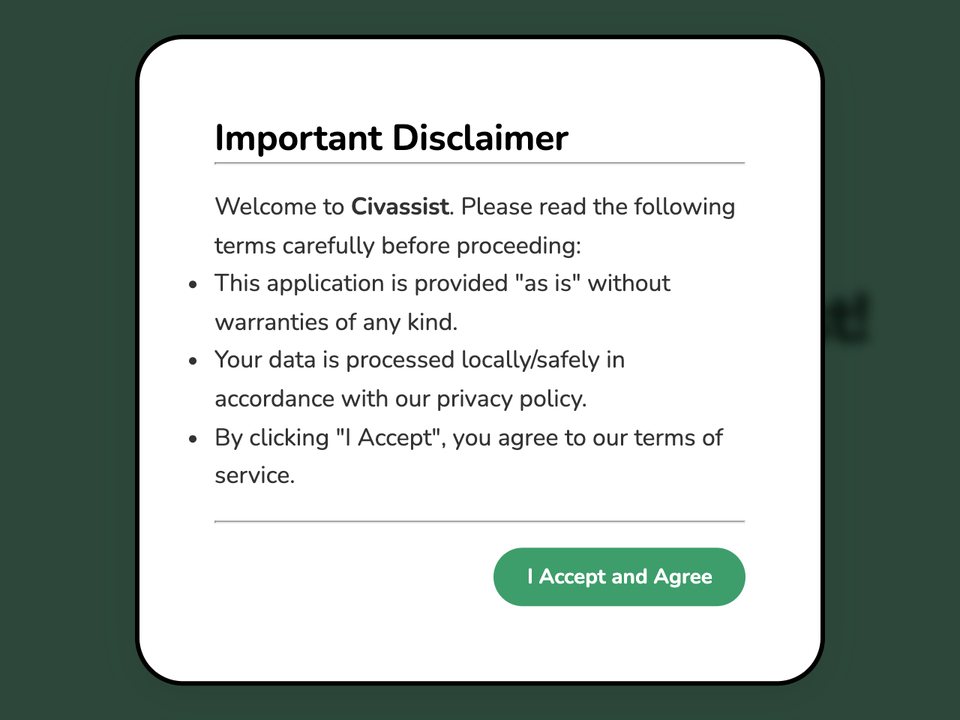
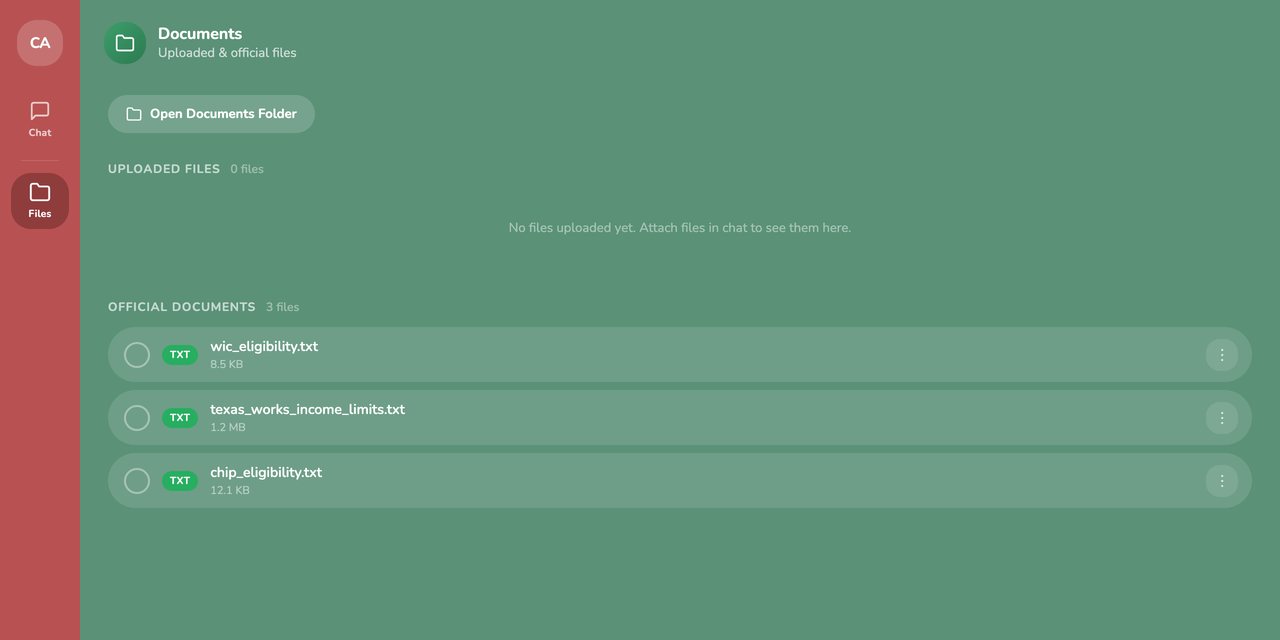
The team split the work three ways. Jay built the chat interface, the files page, the document parsers and the model server, including the two-call flow where one model call talks with the person and a second pulls their answers into a fixed form. Kaylan built the disclaimer, the heartbeat that shuts the local server down when the page closes, and the test setup: a stand-in model, browser tests of the interface and automatic test runs on GitHub. I built the retrieval pipeline and the eligibility engine.
The hard part
The hard part was getting the rules right, and showing they were right. Income limits and other hard facts live in a rulebook that plain Python reads, never in the model, so the model can't invent a limit. That only helps if the rulebook matches the handbook. The rules were transcribed from the handbook with help from Claude, so every rule carries the section it came from, and most carry the exact quote.
To check them, I built an eval in which a judge model reads each rule next to the source text it cites and flags anything the source doesn't support. To test the judge itself, I planted five false rules, from blatant to a boundary flipped by one cent, and it caught all five. Three judges (the local Gemma, Gemini 3.6 Flash and Claude Sonnet) found no transcription errors. Each flag traced to how the harness fed them evidence or to a table whose columns were scrambled in the copy-pasted handbook chart, which I confirmed by arithmetic.
A second eval looks for the opposite problem, a rule the handbook states that the rulebook leaves out. I deleted a real rule and checked that the judge named it, then ran it on the full rulebook. It found three missing rules, including newborns of mothers on Medicaid, who qualify with no income test, and I added them. A last sweep extracted every requirement from the whole source corpus. It found no missing rules but two places where my checker didn't apply a rule the rulebook already stated, and both wrongly turned people down. Both are fixed, with tests.